
Reasoning and Decision-Making Lab
Welcome to the Reasoning and Decision-Making Lab. We develop principled machine learning methods for reliable reasoning and decision-making under uncertainty.
What Makes Us Different?
We are not satisfied with methods that merely work on a few examples. We ask whether a method generalizes, and whether its success is grounded in principles that explain why it works. We pursue both performance and principled understanding without compromise.
Research Showcase
Reliable LLM Reasoning
We study methods for making inference-time reasoning more reliable, efficient, and statistically grounded.
Correct reasoning tends to reproduce its answer after regeneration, while incorrect reasoning is less consistent. Adapted from the Prefix Consistency project page.
- Reliable Chain-of-Thought via Prefix Consistency: We showed that the consistency under regeneration from intermediate reasoning steps is the most informative signal for assessing reasoning quality.
- Best-of-infinity: Asymptotic Performance of Test-Time LLM Ensembling: Studies the asymptotic limits of test-time ensembling and self-consistency.
- CITE: Anytime-Valid Statistical Inference in LLM Self-Consistency: Develops anytime-valid statistical inference for self-consistency-based LLM reasoning.
Sequential Decision-Making
We develop algorithms and theory for learning, identifying good decisions, and searching efficiently under uncertainty.
- Finite-Time Regret Analysis of Retry-Aware Bandits (ReMax): Analyzes a retry-aware bandit algorithm that maximizes the posterior expected best reward over multiple attempts, establishing its first sublinear regret bound.
- Rate-optimal Design for Anytime Best Arm Identification: Studies rate-optimal methods for best-arm identification without a fixed stopping horizon.
- Minimax Optimal Algorithms for Fixed-Budget Best Arm Identification: Characterizes minimax-optimal performance when the sampling budget is fixed.
- An Efficient Algorithm for Thresholding Monte Carlo Tree Search: Develops an efficient search method for thresholding problems on Monte Carlo trees.
Mechanism Design
We design the rules of the game so that people pursuing their own interests lead to good collective outcomes.
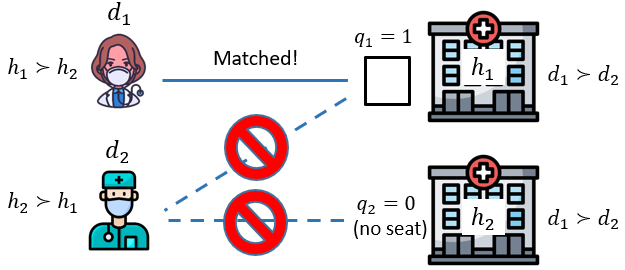
- Anytime Capacity Expansion in Medical Residency Match by Monte Carlo Tree Search: Uses Monte Carlo tree search to optimize flexible capacity expansion in medical residency matching.
- No-Regret Incentive-Compatible Online Learning under Exact Truthfulness with Non-Myopic Experts: We showed that, no-regret online learning with non-myopic incentive compativility is like online learning with bandit (limited) feedback.
- Learning Optimal Dynamic Matching via Graph Neural Networks: Applies graph neural networks to learn policies for dynamic matching problems.
Lab Members
Ph.D. Students
MSc Students
- Hamdan Khaled Ghaith Khalfan Almehairbi
- Atif Quamar
- Artem Perepelitsyn